History Of The Coptic Church
The history of the Coptic Church in Egypt is basically the history of Christianity in Egypt, for the current Coptic Church is a direct evolution from those earlier times. However, it traditionally begins with the visit of the Holy Family to Egypt. Copts relate that the blessing of Christianity on their country goes back to the days when Jesus was a young boy. The holy family, consisting of the baby Jesus, Mary and Joseph traveled to Egypt and lived there for some time.
Numerous traditions exist about the exact locations that the holy family visited, and many take annual pilgrimages following this route (it is also a popular tourist route) However, historically it was Saint Mark the Evangelist, during the first century AD, who actually is considered to be the founder of the church. He preached and suffered martyrdom in Alexandria around the time that Nero ruled Rome.
When St. Mark died in Alexandria in year 68 AD, his body was buried in the chapel at “Beucalis”. In the year 828, the remains were stolen and placed in the Venice cathedral. In 1968 the largest cathedral in Africa was built in Cairo, St. Mark’s Coptic Cathedral. Before the cathedral was finished Pope Paul VI returned to Egypt the body of St. Mark, at the reign of pope kerolos 6th. With much ceremony this was placed in a grave beneath the main altar. Nowadays, weekly meetings are held there where the pope addresses the crowds.
The early Christians of Egypt suffered considerably at the hands of the early Roman pagans, as did others prior to The rule of the Roman emperor, Constantine, who not only legalized their faith, but encouraged it as a Christian himself. However, in 451 AD the Fourth Ecumenical Council took place, and would divide the Catholic, or “universal” Christian church. The decisions of this council concerned the nature of Jesus Christ. The Chalcedonian definition states that Jesus Christ is indeed the Logos incarnate, the very Son of God “born of the Father before all ages.” It affirms that the Virgin Mary is truly Theotokos since the one born from her “according to the flesh” in Bethlehem, is the uncreated, divine Son of God, one of the Holy Trinity.
In His human birth, the Council declared, the Word of God took to Himself the whole of humanity, becoming a real man in every way, but without sin. Thus, according to the Chalcedonian definition, Jesus of Nazareth is one person or hypostasis in two natures – human and divine. He is fully human. He is fully divine. He is perfect God and perfect man. As God, He is “of one essence” (homoousios) with God the Father and the Holy Spirit. As man, He is “of one essence” (homoousios) with all human beings. However, it should be pointed out that, officially, the Coptic Church has never believed in monophysitism the way it was portrayed in the Council of Chalcedon.
According to a statement by the Coptic Church: “Copts believe that the Lord is perfect in His divinity, and He is perfect in His humanity, but His divinity and His humanity were united in one nature called “the nature of the incarnate word”, which was reiterated by Saint Cyril of Alexandria. Copts, thus, believe in one nature from 2 natures human and divine “without mingling, without confusion, and without alteration” (from the declaration of faith at the end of the Coptic divine liturgy). These two natures “did not separate for a moment or the twinkling of an eye” (also from the declaration of faith at the end of the Coptic divine liturgy).”
This split in the church ended up taking the form of persecution against the Coptic Christians of Egypt. After having survived the persecution of the Roman Pagans, they were once again besieged, now by other Christians. Hence, when the Arabs invaded Egypt in the mid-seventh century AD, they met little resistance form the native Christian population.
The Coptic Christian church of Egypt has been responsible for at least several major contributions to the universal Christian faith. Perhaps best known is the founding of monastic establishments. Even before Christianity, it was not uncommon for young Egyptians to retire to the desert for seclusion, perhaps because of the harsh treatment of the Egyptians by the early Romans. Later, with the advent of Christianity, Christians also took to the desert for solitary spirituality and as this movement evolved over time, they sought out like minded individuals, eventually forming themselves into monastic communities. Hence, Egypt is known as the birth place of Christian monasteries. Another outstanding contribution was the Didascalia, the famous catechetical school in Alexandria where early Christian scholars labored to prove that reason and revelation, philosophy and theology were not only compatible, but also essential for each other’s comprehension. This was the first Catechetical School in the world. The first great scholar who served as head of the Didascalia was Pantaenus, who probably ran the school for about a 20 year period between 180 and 200 AD. However, probably the most important theologian and prolific author associated with the school was Origen.
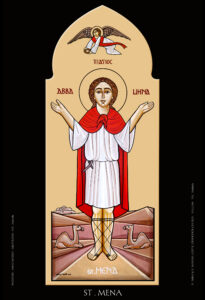
Saint Mina is considered the most well known saint in the East and the West, due to the many miracles that are performed through his prayers for us. Saint Mina was born in Egypt in the year 285, in the city of Niceous which lies in the vicinity of Memphis. His parents were true ascetic Christians named Audexios and Aufimia. On the feast of St. Mary, Aufimia (who had not been blessed with any children) was praying with tears in front of the Icon of the Virgin that God may give her a blessed son. A sound came to her ears saying, "Amen" and thus she called her son Mina. His father, a ruler of one of the administrative divisions in Egypt, died when Mina was fourteen years old. At fifteen, Mina joined the army and because of his father’s reputation, he was given a high ranking and appointed to Algeria. Three years later, he left the army longing to devote his whole life for Christ. He headed towards the desert to live a different kind of life. After he spent five years as a hermit, Mina saw the angels crowning the martyrs with glamorous crowns and he longed to join them. While he was thinking about it, he heard a voice saying: "Blessed are you Abba Mina, because you have been called for the pious life from your childhood. You shall be granted three immortal crowns; one because of your celibacy, the second because of your asceticism and the third because of your martyrdom." Immediately he felt as if the earth under him was vanishing, and he was overwhelmed with great eagerness to be carried away to heavens. In a mood of valour he hurried to the ruler, declaring his Christian faith. His endless sufferings and the tortures that he endured attracted many of the pagans not only to Christianity, but also to martyrdom.
It happened that while a shepherd was feeding his sheep in that area, a sick lamb fell upon the ground. As it struggled to rise to its feet, the sheep’s scab was cured. The story was quickly spread and the sick who came upon this spot recovered from whatever illnesses they had, just by laying on the ground. During that time, the daughter of King Zinon, the Christ-lover, caught leprosy. His advisor’s suggested that she should try that place, and she did. At night, St. Mina appeared to the girl and informed her that his body was buried in that place. The following morning, she bathed in the well and was healed. She related her vision about St. Mina to her servants and how he had cured her. St. Mina in Marriout Immediately, King Zinon ordered St. Mina’s body to be dug out, and a church to be built in that place. He also ordered a large city to be built and named in honour of St. Mina. Sick people from all over the world used to visit that city and were healed by the intercession of St. Mina, the miracle-maker.
St. Mina’s assassins tried to burn his relics but they failed, so the believers loaded his body on a camel and headed towards the western desert. At a certain spot, the camel stopped and the people could not force it to continue its trip by any means. The people buried the body of St. Mina near a water well (that place is his present monastery at the end of Marriout Lake, not far from Alexandria).
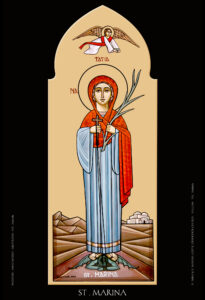
St. Marina was born in 230 A.D., in the city of Pyssidya, Antioch in the middle of Asia Minor. She was the only daughter of 2 pagan parents (idol worshippers). Her father, Dacious, was the high priest of the idol temple. Her mother died while Marina was 5 years old. While Marina was at an early age she needed a lot of attention after her mother passed away. Her father decided to bring a teacher to look after his only daughter. The teacher was a Christian woman, who lived in a very small village next to their city. This teacher had great faith in the Lord Jesus Christ. Marina felt great joy and happiness while she was with her teacher, and she realized she did not wish to follow her parents’ religious lifestyle.
When Marina was fifteen years old, her father passed away. Marina continued loving and obeying her teacher and her teacher also considered Marina's life as one of the Lord's gifts and blessings, for Marina was a beautiful righteous youth. The teacher planted the seeds of the sound and right Christian faith in the heart of young Marina in her early age. Marina entered into a new period of her life, during which she had to face severe punishment and persecutions because of her love and dedication to the Lord Jesus Christ. A new governor came to the city whose name was "Wali-Farnos". This evil governor accompanied his troops looking for Christians to persecute. He spotted Marina walking out with her companions. When he saw her beauty he decided to take her as a wife if she was a free woman, but if she was a slave, he wanted to pay to free her from her master. When the soldiers tried to arrest her, she called on the Lord Jesus Christ her heavenly bridegroom to save her. The soldiers returned to the governor and said, “We couldn't arrest this young woman because she is Christian."
The Governor started to panic after hearing this news, and he ordered his soldiers to bring Marina in chains to stand in front of him and answer his questions. When he started asking her where she came from, she said, "I am Christian and not a slave." Then the governor asked, "From which tribe do you come?" and "What is your name?" Marina replied, "I am from the tribe of Jesus Christ," and "I am Marina." The Governor ordered Marina to be tortured and he tied her up with rope and started beating her with sticks and whips. Then he ordered the soldiers to comb her body with an iron comb, saw her body with an iron saw, and cut her skin to little pieces with knives. They dragged her and hanged her and burned her body with torches. Every time they tortured Marina, Archangel Michael came and healed her with the sign of the cross. Marina also overcame the devil with the sign of the cross while she was in prison. In the morning, the Governor ordered Marina to be placed in a tub of boiling water, but the Lord made the water warm, and she received the holy baptism. At this moment the people proclaimed their belief in Jesus Christ. The governor ordered the beheading of these believers, as well as the beheading of St Marina.
St. Marina received the crown of martyrdom. Many miracles have also occurred through the prayers and intercessions of Saint Marina till this day.